Log In
LeadTruffle Insights
HVAC Lead Generation: The Complete Guide for 2026
Learn how to generate HVAC leads without overpaying for shared leads. Covers Google Business Profile, LSA, Google Ads, reviews, referrals, and why speed-to-lead and book rate matter more than raw CPL.
Short Answer
tl;dr: HVAC leads are some of the most expensive in home services -non-branded search leads average $149 each, and AC repair leads can hit $231. But raw cost per lead is the wrong metric. What matters is your book rate and cost per paying customer. The HVAC companies winning in 2026 combine Google LSA, a strong Google Business Profile, and fast response times. They don’t rely on one channel -top performers use 3 to 5 lead sources. And HVAC is the slowest-responding trade, with only 11% of businesses replying within an hour. Fix that and you’re already ahead of most competitors.
HVAC lead generation is expensive and competitive. WordStream’s 2025 benchmarks put the Home & Home Improvement category at $7.85 average CPC and $90.92 average CPL -and HVAC specifically runs well above those averages. SearchLight’s January 2026 benchmark across 816 contractors and $14.88 million in ad spend showed a blended CPL of $104 and a non-branded CPL of $149.
But context matters. BLS projects HVAC technician employment to grow 8% from 2024 to 2034, driven by repair and replacement work plus energy-efficiency retrofits. The median age of owner-occupied homes in the U.S. is 41 years, and 17% were built before 1950. Old systems break down. Homeowners need HVAC work whether the economy is great or not.
Jobber’s 2026 Home Service Trends Report surveyed 1,050 home-service business owners and found 58% reported increased demand, with 80% saying they were fully booked or close to it. The demand is there. The question is whether you’re capturing it efficiently or overpaying for leads you can’t convert.
This guide covers what works in 2026: which channels deliver the best ROI, what leads actually cost by service line, and why your response time might matter more than your ad budget.
HVAC Lead Costs Are Not One Number
One of the biggest mistakes in HVAC marketing is treating “HVAC leads” as a single category. Different service lines have wildly different economics.
Cost Per Lead by Service Line
SearchLight’s January 2026 non-branded benchmarks across 8,077 campaigns and 143,008 leads:
| Service Line | Non-Branded CPL | Notes |
|---|---|---|
| Heating Repair | $144 | Seasonal, winter-heavy |
| AC Repair | $231 | Most expensive, summer spike |
| General HVAC | $198 | Broad searches, lower intent |
| Indoor Air Quality | $274 | High CPL, niche market |
| Water Heater | $343 | Highest CPL, emergency-driven |
| Blended (all services) | $104 | Includes branded searches |
| Performance Max | $72 | Lower CPL, mixed intent |
These numbers are from paid search specifically. Your actual CPL will vary by market, season, and campaign quality. But the pattern is clear: lumping all HVAC services into one campaign hides the real economics.
Cost Per Lead by Channel
| Channel | Cost Per Lead | Close Rate | Notes |
|---|---|---|---|
| Google PPC (non-branded) | $149 | 15-30% | Expensive, high intent |
| Google LSA | $40-$80 | 20-35% | Pay per lead, Google Guaranteed |
| Performance Max | $72 | Varies | Lower CPL, mixed quality |
| Facebook/Instagram | $20-$60 | 10-20% | Lower intent, needs follow-up |
| Lead Aggregators | $50-$100 | 8-15% | Shared leads, competitive |
| SEO/Organic | <$40 | 25-40% | Slow to build, best long-term ROI |
| Referrals | ~$0 | 50%+ | Highest conversion rate |
CPL Is the Wrong Metric
Here’s the insight most HVAC marketing articles miss: cost per lead doesn’t tell you much by itself. What matters is your book rate -the percentage of leads that become paying customers -and your cost per booked job.
A $149 lead that books at 30% costs you $497 per customer. A $72 Performance Max lead that books at 10% costs you $720 per customer. The cheaper lead was actually more expensive.
Track cost per booked job, not just CPL.
Google Business Profile: Your Most Important Free Asset
When someone searches “HVAC near me” or “AC repair [city name],” 42% of local searchers click the Google Maps Pack, according to Backlinko’s study of 454 U.S. users. That means your Google Business Profile is often the first thing potential customers see.
The Basics That Too Many HVAC Companies Get Wrong
Jobber’s 2026 report found alarming gaps in how home-service businesses present themselves online:
- 43% do not clearly list their service areas
- 65% do not show business hours
- 74% are missing an FAQ section
These are free fixes. Before you spend another dollar on ads, make sure your profile isn’t leaking leads through basic gaps.
Optimization Checklist
- Verify your business -Google’s screening process takes 3 to 4 weeks on average, so start early
- List every service -separate entries for AC repair, heating repair, installation, maintenance, duct cleaning, indoor air quality, water heater service
- Define service areas accurately by city or zip code
- Add 15+ high-quality photos -completed installations, your team at work, branded vehicles, equipment
- Post business hours and update them seasonally (extended hours during peak cooling/heating season)
- Enable messaging and booking -Google says having these features on can improve ad ranking
- Respond to every review -more on this below
Google Posts
Use Google Posts to share seasonal promotions, maintenance tips, and updates. “AC tune-up special -book before May 1st” is the kind of content that converts searchers who are comparing options.
Reviews: The Trust Multiplier
BrightLocal’s 2026 Local Consumer Review Survey (1,002 U.S. adults) makes the case clearly:
- 97% of consumers read reviews for local businesses
- 41% “always” read them before choosing
- 47% won’t use a business with fewer than 20 reviews
- 74% want reviews from the last 3 months
- 31% only use businesses with 4.5+ stars
- 37% factor in whether the owner responded to reviews
That 74% stat about recency is the one most HVAC companies miss. Having 200 reviews is great, but if your most recent one is from six months ago, it signals to customers that something changed.
How to Build a Review Engine
- Ask after every completed job -the best time is when the customer is satisfied, right after the system is working again
- Send a text with a direct Google review link -make it one tap, not a multi-step process
- Respond to every review within 24-48 hours -positive and negative
- Write real responses -50% of consumers are put off by generic templated replies
- Don’t buy reviews or selectively solicit -the FTC fake review rule has been in effect since October 2024
Where Reviews Are Headed
BrightLocal also reported that Google’s share as a review discovery source fell from 83% to 71%, while generative AI tools like ChatGPT jumped from 6% to 45% as a recommendation source. This means your review content is being consumed not just by humans browsing Google, but by AI systems that recommend local businesses. Complete profiles with fresh, substantive reviews give these systems more signal to work with.
Google Local Services Ads (LSA)
HVAC is an eligible category for Google Local Services Ads, and for many contractors it delivers the best paid ROI.
Why LSA Works for HVAC
- Pay per lead, not per click -you only pay when someone contacts you
- Google Guaranteed badge -builds instant trust, especially for emergency repairs
- Lower CPL than search ads -typically $40-$80 vs $149+ for non-branded search
- Reviews from your GBP feed directly into LSA -strong reviews = better ad position
- You can dispute invalid leads for credit
The Responsiveness Factor
Google’s own documentation says that if you regularly fail to answer calls or respond to messages, your ad ranking may be affected. This is a real problem for HVAC companies: you’re on a roof, inside a crawlspace, or driving between jobs when leads come in.
Jobber’s data confirms HVAC is the slowest-responding trade, with just 11% hitting a within-the-hour response window. That means if you can respond within minutes instead of hours, you have a structural advantage over 89% of your competitors.
Setting up automated text-back for missed calls or using an AI answering service keeps your LSA ranking healthy even when you’re on a job.
LSA Inconsistency Is Real
It’s worth noting that LSA results can be inconsistent. Reddit threads include examples of contractors with 300+ five-star reviews getting only 2-3 leads on $1,000/month. LSA isn’t guaranteed to work in every market for every service line. Test it, measure book rate (not just lead volume), and adjust.
Google Search Ads (PPC)
Google search ads put you at the top of results for high-intent searches like “AC repair near me” or “furnace replacement [city].”
The Numbers
Google Ads CPC for HVAC has risen significantly. WordStream reports the overall Google Ads average CPC rose 12.88% year-over-year in 2025, and Home & Home Improvement is one of the most expensive categories. Some HVAC operators report $50+ minimum clicks in competitive markets.
What Works
- Separate campaigns by service line -heating repair, AC repair, installation, and maintenance have different economics and different seasonal patterns
- Build dedicated landing pages for each service -don’t send AC repair clicks to your homepage
- Use location targeting -only show ads in areas you actually serve
- Add call extensions -most HVAC leads come from phone calls
- Negative keywords are critical -filter out “DIY,” “how to,” “jobs,” “salary,” “training,” and “certification” searches
- Use call tracking -know which keywords produce paying customers, not just clicks
Seasonal Budget Strategy
HVAC has two natural demand peaks: summer (AC) and winter (heating). Pre-season is when your marketing dollar goes furthest. By the time it’s 95 degrees and everyone’s AC is broken, CPCs spike because every HVAC company is bidding aggressively.
Front-load spend in late spring for cooling and late fall for heating. Maintenance campaigns can run year-round at lower spend.
Website and SEO
Your website is the foundation everything else sits on. Housecall Pro’s research (1,040 U.S. homeowners) found that 96% expect a user-friendly professional website and 80% factor online booking into choosing a pro. If your website is slow, confusing, or doesn’t work on mobile, you’re losing leads you already paid to attract.
Service Pages
Create individual pages for each service:
- AC repair and installation
- Heating and furnace repair
- Heat pump installation
- Duct cleaning and repair
- Indoor air quality
- Water heater service
- Preventive maintenance plans
- Emergency/after-hours service
Each page should target location-specific keywords: “AC repair in [city],” “furnace installation [county].”
Conversion Basics
- Phone number prominent on every page (click-to-call on mobile)
- Contact form on every service page
- Online booking or scheduling option
- Clear service areas listed
- Business hours displayed (including emergency/after-hours availability)
- FAQ section answering common questions
Remember: 43% of home-service businesses don’t clearly list service areas, 65% don’t show hours, and 74% are missing FAQs. Fix these and you’re already ahead.
Blog Content
Answer questions homeowners actually search:
- “How much does a new AC unit cost?”
- “How often should I service my HVAC system?”
- “What size AC do I need for my house?”
- “Why is my furnace blowing cold air?”
- “HVAC maintenance checklist”
This content brings in people researching HVAC and signals to Google that your site is authoritative in the space.
After-Hours Lead Capture
This is one of the most underappreciated factors in HVAC lead generation.
Housecall Pro’s 2026 data says 41% of jobs booked online come in after hours. Homeowners are reaching out later in the evening, not during business hours. If your phone goes to a generic voicemail at 6 PM, you’re missing nearly half your potential bookings.
HVAC emergencies don’t wait for business hours. A furnace failure at 10 PM or an AC breakdown on a Saturday afternoon generates some of the highest-intent leads possible. The question is whether anyone answers.
Options for After-Hours Coverage
- Live answering service -human operators, typically $1-$3 per call, but quality varies
- AI answering service -automated phone and text response that qualifies leads 24/7
- Automated text-back -when a call goes unanswered, immediately text the caller to acknowledge the missed call and start qualification
- Online booking -let customers schedule from your website without needing to call
Housecall Pro also found that 53% of homeowners are comfortable with AI handling initial inquiries. The bar for after-hours coverage is lower than many contractors assume -customers just want to know someone received their message and will follow up.
Lead Aggregators: The Debate
Platforms like Angi, HomeAdvisor, Thumbtack, and Service Direct sell HVAC leads. Jobber’s data shows lead generation sites account for 16% of leads for home-service businesses.
The Case Against (Mostly)
Reddit sentiment from HVAC operators is overwhelmingly negative on Angi/HomeAdvisor specifically. Common complaints:
- Leads are shared with multiple contractors
- Leads arrive outside service area
- Quality is inconsistent
- Long contracts and difficult cancellation
- Refund process for bad leads is frustrating
The structural problem is the same across all trades: shared leads put you in a speed-and-price competition with 3-5 other contractors calling the same homeowner at the same time. That drives down margins and builds zero brand equity.
When They Might Make Sense
- You’re new and need any jobs to build reviews
- You have technicians sitting idle and need to fill schedules
- You’re testing a new market or service area
- You treat them as a minor supplement (under 20% of leads), not your strategy
The Math
If aggregator leads cost $75 and close at 10%, your cost per customer is $750. If your own Google Ads leads cost $149 and close at 25%, your cost per customer is $596 -and you built brand recognition in the process.
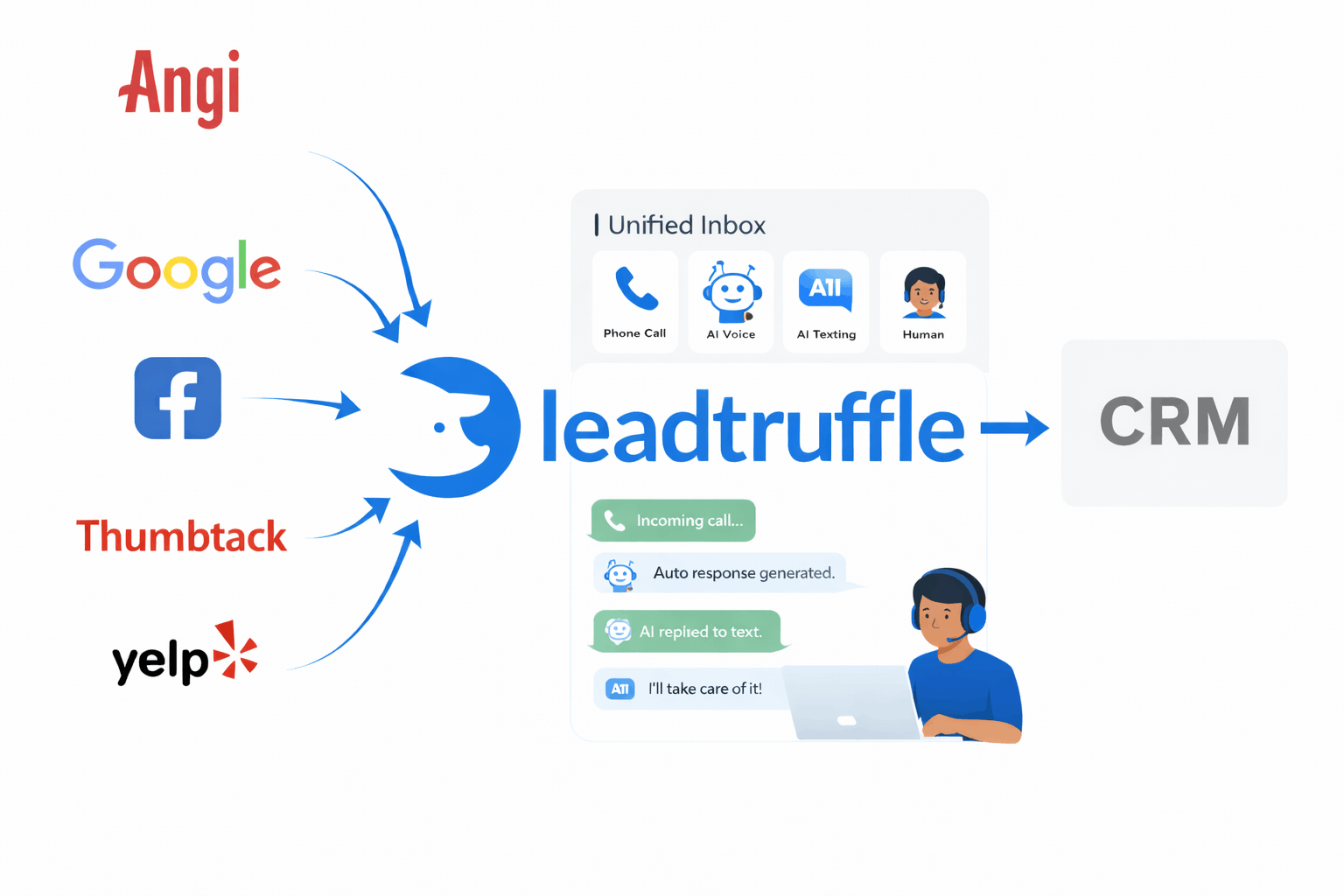
If you do use aggregator platforms, having leads from Angi, Yelp, and Thumbtack flow into a unified inbox and get an immediate AI response dramatically improves your odds of being the first to connect.
Referrals: Still the Best Channel
Jobber’s 2026 data confirms what every HVAC contractor already knows: referrals and repeat customers are the top lead sources at 59% each. No other channel comes close.
Referral leads close above 50% because the trust is pre-built. When someone’s neighbor says “call this company, they fixed my AC in two hours,” the homeowner isn’t shopping around -they’re calling you.
Building Referral Flow
- Ask after every completed job -don’t assume customers will think of it
- Offer a meaningful incentive -$50 credit, discount on maintenance plan, gift card
- Maintenance agreements create referral loops -customers on annual plans interact with you repeatedly and are more likely to recommend you
- Follow up at 30, 90, and 365 days -referral opportunities often arise weeks after service
Partnerships
Build relationships with complementary businesses:
- Plumbers -water heater and hydronic heating crossover
- Electricians -panel upgrades for new HVAC systems
- Real estate agents -HVAC inspections on home sales
- Home inspectors -they flag HVAC issues constantly
- Property managers -recurring maintenance contracts plus emergency calls
- General contractors -new construction and renovation projects
Diversify Your Sources
Jobber’s data shows top-performing home-service businesses use 3 to 5 lead sources. After referrals and repeat customers, the next most common channels are Facebook (32%), local networking and partnerships (25%), Google Search (20%), and LSAs (19%).
Don’t rely on one channel. A balanced mix of referrals, organic search, LSA, and one or two paid channels gives you stability when any single source fluctuates.
Speed to Lead: HVAC’s Biggest Problem
We’ve mentioned response speed repeatedly because the data is overwhelming -and because HVAC is uniquely bad at it.
Jobber’s findings: 60% of home-service pros reply the same day, 20% within the hour, but HVAC businesses are the slowest-responding trade with just 11% hitting a within-the-hour response window.
That creates a structural opportunity. If you can respond to leads within minutes, you’re faster than roughly 89% of your competitors. In a category where the average CPC is $8+ and leads cost $100-$200, the speed at which you handle those leads is arguably more important than how much you spend to generate them.
Why HVAC Response Is Slow
It’s not laziness -it’s the nature of the work. Technicians are inside equipment rooms, on roofs, in crawlspaces. They can’t answer phones mid-repair. Office staff, if they exist, are often handling scheduling and dispatch. After hours, nobody’s there.
How to Fix It
- Automated text-back for missed calls -the caller gets an instant text acknowledging their call and asking about their issue
- AI qualification over text -collects service needed, address, timeline, and urgency level while you’re on another job
- AI phone answering -an AI voice agent picks up when you can’t, qualifies the caller, and sends you the details
- Instant notifications -every lead triggers a push notification so you can call back during your next break
- Online booking -let customers self-schedule without needing a phone conversation
The goal isn’t to replace the personal touch. It’s to make sure every lead gets an immediate response so they don’t call the next company on the list.
Social Media: Facebook and Beyond
Facebook is the third most common lead source at 32%, according to Jobber. For HVAC, social works differently than search.
What Works
- Seasonal content -“5 signs your AC needs service before summer” gets shares
- Before/after content -new system installations, duct work, thermostat upgrades
- Emergency-weather campaigns -target your area after heat waves or cold snaps
- Maintenance plan promotions -recurring revenue is the best kind
- Retargeting -show ads to people who visited your website but didn’t convert
- Lead forms -capture contact info without making people leave Facebook
Expectations
Social leads are colder than search leads. Someone scrolling Facebook isn’t actively looking for HVAC help -you’re interrupting them. Expect lower close rates (10-20%) but also lower CPL ($20-$60). Budget for follow-up: these leads often need 2-3 touches before they convert.
Tracking and Measurement
Track these numbers monthly:
Cost per lead by channel -know whether your LSA leads cost $50 and your Google search leads cost $150.
Book rate by source -what percentage of leads from each channel become paying customers? This is more important than raw CPL.
Cost per booked job -CPL ÷ book rate. This is the number that actually matters for profitability.
Response time -measure it for every lead. How many minutes between the lead coming in and your first response?
Revenue per customer by service line -an AC installation customer is worth $8,000-$15,000. A tune-up customer is worth $150 but might convert to a maintenance plan worth $300+/year.
Seasonal patterns -compare performance across months. Adjust budget and channel allocation accordingly.
Use tracking phone numbers for different marketing sources. Tag leads by channel in your CRM. Ask every customer how they found you.
Common Mistakes
Treating HVAC as One Service Line
Running one Google Ads campaign for “HVAC” wastes money. AC repair, heating repair, installation, IAQ, and water heater services have different CPLs, different seasonal patterns, and different customer values. Separate them.
Slow Response Time
HVAC is the worst-performing trade for response speed. Every hour you take to respond pushes the close rate down. Fix this before increasing ad spend.
Ignoring Review Recency
Having 150 reviews from 2024 doesn’t help much if your last review is six months old. 74% of consumers want reviews from the last 3 months. Make review collection a weekly habit, not a quarterly project.
Missing Basic Website Information
43% of businesses don’t list service areas. 65% don’t show hours. 74% skip FAQs. These are free fixes that improve both user experience and SEO. Do them today.
Over-Reliance on Lead Aggregators
Lead-gen platforms should supplement your strategy, not define it. If more than 20% of your leads come from shared-lead marketplaces, you’re building on rented land. Invest in channels you own.
Ignoring After-Hours Leads
41% of online bookings come in after hours. If your business effectively shuts down at 5 PM for lead capture, you’re leaving a huge portion of demand on the table -especially for emergency services where urgency and willingness to pay are highest.
What to Do Next
A practical sequence for building or improving HVAC lead generation:
1. Fix the leaks first List your service areas, show your hours, add an FAQ section, and make sure your phone number is prominent and click-to-call on mobile. These are free and fast.
2. Optimize your Google Business Profile Complete every field. Add 15+ photos. Enable messaging and booking. Start the verification process now -it takes 3-4 weeks.
3. Set up response time infrastructure Automated text-back for missed calls. Instant notifications for every lead. Consider an AI answering service for after-hours and overflow calls.
4. Start Google LSA HVAC is eligible. Pay per lead, not per click. The Google Guaranteed badge matters for high-ticket services. Maintain responsiveness to protect your ranking.
5. Build your review engine Text every customer a review link on the day of service. Respond to every review. Aim for a steady stream of new reviews every month, not batches.
6. Launch service-specific Google Ads campaigns Separate campaigns for AC repair, heating, installation, and maintenance. Dedicated landing pages for each. Track book rate and cost per customer, not just CPL.
7. Create a referral system Ask every customer. Offer an incentive. Follow up at 30 and 90 days. Build partnerships with plumbers, electricians, and real estate agents.
8. Invest in SEO Service pages, location pages, and blog content. This takes months but compounds over time.
9. Diversify to 3-5 sources Top performers don’t rely on one channel. Mix referrals, LSA, search ads, organic, and social. Measure each one and shift budget quarterly.
Speed Up Your Lead Response
HVAC is the slowest-responding trade in home services, and it has some of the highest lead costs. That combination means every minute of delay is expensive.
LeadTruffle helps HVAC companies respond instantly to website leads, missed calls, and form submissions -even at 10 PM on a Saturday when a furnace goes out. The AI qualifies leads through text or voice conversation, collecting service needed, address, urgency, and system details, then hands off qualified leads ready for you to dispatch.
All your leads from every source -website, missed calls, Google LSA, Yelp, Angi, Thumbtack -show up in one unified inbox. No more checking five apps between service calls.