Log In
LeadTruffle Insights
Landscaping Lead Generation: The Complete Guide for 2026
Learn how to generate landscaping leads without overpaying for shared leads. Covers Google Business Profile, LSA, SEO, paid ads, referrals, reviews, and why speed-to-lead matters more than ever.
Short Answer
tl;dr: The landscaping industry hit $188.8 billion in 2025 with nearly 700,000 businesses competing for work. The companies winning leads in 2026 own their marketing channels (SEO, Google Business Profile, referrals) instead of renting shared leads from aggregators. Reviews are the biggest lever -47% of consumers won’t use a business with fewer than 20 reviews. And speed matters: the landscaper who responds first usually gets the job. This guide breaks down what actually works channel by channel and what each one costs.
The U.S. landscaping industry is massive. NALP’s 2025 economic report puts it at $188.8 billion in annual revenue, with 692,777 businesses and over 1.4 million people employed. That’s roughly 6.5% annual growth over the past five years, with moderate growth forecast for 2026.
The typical landscaping company serves about 355 customers and grows revenue around 8.5% per year. Those numbers sound healthy until you factor in the competition. Nearly 700,000 businesses are fighting for the same homeowners, and the ones who show up first -both in search results and in response time -get the work.
What makes landscaping lead generation different from other trades is seasonality. Demand spikes hard in spring, plateaus through summer, and drops off in fall. Your marketing strategy needs to account for that. An ad campaign that works great in April might burn money in July.
This guide covers what works in 2026: which channels deliver the best ROI, what leads actually cost, and how to build a pipeline that doesn’t depend on renting leads from someone else.
Why Landscaping Leads Are Worth Fighting For
Before getting into tactics, it helps to understand why homeowners buy landscaping services in the first place. It’s not just about a nice yard.
According to the National Association of REALTORS and NALP’s Remodeling Impact Report, 97% of real estate agents say curb appeal is important for attracting buyers. Standard lawn care service has an estimated 217% cost recovery at resale. Landscape maintenance comes in at 104% cost recovery.
That means homeowners who spend $1,000 on professional lawn care can expect to recoup roughly $2,170 in home value. That’s a strong selling point -and it means price-sensitive homeowners still have real financial incentive to hire a landscaper.
Thumbtack and NALP survey data backs this up: 62% of homeowners planned a landscaping project, and 69% said curb appeal matters to them. The most common pain points were weeds, keeping grass alive, and figuring out what maintenance fits their budget.
Design trends are shifting too. Houzz’s 2025 search data showed growing interest in low-water and Mediterranean-style landscaping, with searches for succulent gardens up roughly 3x and decomposed granite landscapes up 37%. If you offer drought-tolerant or xeriscaping services, that’s a growing segment worth targeting in your marketing.
The Cost of Landscaping Leads by Channel
Understanding lead costs helps you budget and compare. Here’s what the current data shows for landscaping and lawn care businesses.
| Channel | Cost Per Lead | Close Rate | Notes |
|---|---|---|---|
| Google PPC | $80-$110 | 15-30% | High intent, competitive keywords |
| Google LSA | $25-$60 | 20-35% | Pay per lead, Google Guaranteed badge |
| Facebook/Instagram | $15-$50 | 10-20% | Lower intent, best with visual content |
| Lead Aggregators | $25-$75 | 8-15% | Shared with multiple competitors |
| SEO/Organic | <$30 | 25-40% | Takes time, best long-term ROI |
| Referrals | ~$0 | 40-60% | Highest conversion rate |
| Yard Signs | $3-$10 | Varies | Best near completed jobs |
| Direct Mail | $15-$40 | 5-15% | Good for targeted neighborhoods |
Industry PPC benchmark data from Evergrow Marketing showed landscaping and lawn care businesses averaging roughly 5% click-through rate, $3.65-$3.81 CPC, and $87-$104 cost per lead depending on the year. Those are directional benchmarks, not universal numbers -your market and campaign quality will shift results significantly.
The seasonality matters here. April tends to be the strongest month for landscaping ad performance. By midsummer, costs often rise and conversion rates drop. Plan your budget accordingly.
Exclusive vs Shared Leads
This is the same distinction that matters across every home service trade.
Exclusive leads come directly to you -your website, your ads, your referral network. You’re the only company talking to that homeowner.
Shared leads from aggregators get sent to 3-5 landscapers simultaneously. Everyone calls at once. The homeowner picks whoever responds fastest or quotes the lowest price.
The math is straightforward: a $40 exclusive lead that closes at 25% costs you $160 per customer. A $30 shared lead that closes at 10% costs you $300 per customer -and you built nothing for your brand.
Over time, the gap widens. Exclusive lead channels (SEO, your own ads, referrals) compound. Shared lead channels stay flat or get more expensive.
Google Business Profile: The Foundation
Your Google Business Profile (GBP) is the single most important free asset for landscaping lead generation. It’s what shows up in the Map Pack when someone searches “landscaper near me” or “lawn care [city name].”
Setting Up Correctly
Many landscapers work from home or a yard, not a storefront. Google has specific rules for service-area businesses:
- Hide your physical address if you don’t serve customers at that location
- Define your service areas by city, county, or zip code
- Keep services and hours accurate and updated seasonally
- Add photos and videos -completed projects, your crew, equipment, before/after shots
For verification, Google may require video verification for service-area businesses. They want to see real-world proof: your neighborhood context, branded vehicles or uniforms, equipment, and business documents. Have these ready.
Photos Matter More Than You Think
Google’s own guidance says photos and videos improve your GBP performance. For landscapers, this is a natural advantage -your work is visual.
Upload at least 15-20 photos:
- Before and after shots of major projects
- Seasonal work (spring cleanups, fall leaf removal, snow removal)
- Your crew working on-site
- Equipment and trucks (especially if branded)
- Finished hardscaping, planting, and design work
Update photos regularly. A profile with photos from 2023 tells potential customers you’re not active.
Reviews: The Biggest Lever
BrightLocal’s 2026 Local Consumer Review Survey makes it clear how much reviews matter:
- 97% of consumers use reviews for local businesses
- 92% care about star ratings
- 47% won’t use a business with fewer than 20 reviews
- 74% want reviews from the last three months
- 80% are more likely to use a business that responds to every review
That last stat is critical. Responding to reviews -even negative ones -directly influences whether new customers choose you. And 50% of consumers are put off by generic templated replies, so write real responses.
After every completed job, ask for a review. The easiest approach: send a text message with a direct link to your Google review page. Do it the same day you finish the work, while the customer is looking at a fresh yard.
One important note: the FTC’s fake review rule took effect on October 21, 2024. Don’t buy reviews, don’t write fake testimonials, and don’t selectively solicit only happy customers. Keep it legitimate.
SEO: The Long Game That Compounds
Organic search traffic from your website costs nothing per click and compounds over time. A blog post or service page that ranks well will generate leads for years.
Service Pages
Create separate pages for each service you offer:
- Lawn mowing and maintenance
- Landscape design and installation
- Hardscaping (patios, retaining walls, walkways)
- Irrigation and sprinkler systems
- Tree and shrub care
- Seasonal cleanups
- Snow removal (if applicable)
A single “Services” page doesn’t rank for specific searches. Someone searching “patio installation [city]” should land on a dedicated patio page.
Location Pages
If you serve multiple cities or suburbs, create a page for each one. “Lawn Care in [City Name]” with locally relevant content -neighborhoods you work in, local conditions, photos of work done in that area.
Blog Content
Answer questions homeowners actually search for:
- “How much does landscaping cost?”
- “When should I start spring lawn care?”
- “How often should I water new sod?”
- “Best low-maintenance landscaping ideas”
This content brings in people researching landscaping. Some percentage will hire you. And even if they don’t, the traffic signals to Google that your site is authoritative.
Technical SEO Basics
- Mobile-friendly (most local searches happen on phones)
- Fast page load (under 3 seconds)
- Clear call-to-action on every page
- Schema markup for local business
- Consistent NAP (name, address, phone) across the web
Google Local Services Ads (LSA)
Google LSA is one of the highest-value paid channels for landscapers. These are the ads at the very top of Google search results with the green “Google Guaranteed” checkmark.
Google explicitly lists landscaping services, lawn care services, snow removal services, and tree services as eligible LSA categories.
Why LSA Works for Landscapers
- Pay per lead, not per click -you only pay when someone actually contacts you
- Google Guaranteed badge builds trust instantly
- Lower cost per lead than standard Google Ads (typically $25-$60)
- Message leads are often cheaper than phone leads
- You can dispute invalid leads for credit
How to Rank Higher in LSA
Google’s own documentation says LSA ranking is influenced by:
- Responsiveness -how quickly you respond to leads
- Response rate -what percentage of leads you respond to
- Review rating and count -more reviews, higher rating = better placement
- Photos -complete profiles with real photos rank better
- Verification status -Google Screened/Guaranteed
- Relevance -matching the right services to the search
- Messaging/booking enabled -having these features turned on
The responsiveness factor is key for landscapers. If you’re out mowing and can’t answer calls immediately, you lose ranking position over time. This is where having an AI answering service or automated text-back system makes a real difference -not just for catching the lead, but for maintaining your LSA ranking.
Google Ads (PPC)
Google search ads put you above organic results for high-intent searches like “landscaping company near me” or “lawn care service [city].”
What the Numbers Look Like
Based on industry benchmark data:
- Average click-through rate: ~5%
- Average cost per click: $3.50-$4.00
- Average conversion rate: 3.5-4%
- Average cost per lead: $87-$104
These are averages. Your actual numbers depend on your market, competition, keyword selection, landing page quality, and ad copy.
What Works
- Separate campaigns by service -don’t lump lawn mowing, landscape design, and tree removal into one campaign
- Send traffic to dedicated landing pages, not your homepage
- Use location targeting -only show ads in areas you actually serve
- Add call extensions so people can tap to call from mobile
- Use negative keywords -filter out “DIY,” “how to,” “jobs,” and “salary” searches
- Optimize for GBP with real photos and reviews to strengthen your ad presence
- Use call tracking so you know which keywords produce real customers
Seasonality Strategy
Don’t run the same budget year-round. Ramp up in March-April when homeowners are planning spring projects. Scale back in midsummer when conversion rates drop. Consider a fall push for cleanup services and a winter campaign for snow removal if you offer it.
Social Media Advertising
Facebook and Instagram ads cost less per lead than Google but produce colder leads. People scrolling Instagram aren’t actively searching for a landscaper -you’re interrupting them.
What Works for Landscapers
Landscaping has a huge advantage on social: the work is extremely visual.
- Before/after photos and videos -these stop the scroll better than almost anything
- Tight geographic targeting -target specific zip codes or a radius around your service area
- Seasonal offers -“Spring cleanup special: book by March 31st”
- Lead forms that capture contact info without leaving Facebook
- Retargeting people who visited your website but didn’t convert
Reddit threads suggest Meta lead forms can work for landscaping, especially with strong visual creative and narrow targeting, but results vary widely by campaign quality.
Social leads need more follow-up than search leads. Budget for that. An automated text-back or AI lead qualifier helps convert these cooler leads before they go cold.
Cost Expectations
Expect $15-$50 per lead from Facebook/Instagram. Lower than Google, but lower intent too. Close rates will run 10-20% compared to 25-40% for organic search leads.
Lead Aggregators: When They Make Sense (and When They Don’t)
Platforms like Angi, Thumbtack, and Houzz sell landscaping leads to multiple contractors.
The Standard Model
- Homeowner submits “I need landscaping”
- Platform sells that lead to 3-5 landscapers
- Everyone calls at once
- Homeowner picks whoever responds first or quotes lowest
The sentiment among landscaping business owners is mostly negative toward these platforms. Common complaints: shared leads, inconsistent quality, thin margins, and no brand equity built.
The more nuanced reality is that some operators get value for narrow services like one-off cleanups or small maintenance jobs where speed-to-respond is the only differentiator.
When Aggregators Might Work
- You’re new and need reviews from any source
- You have crew availability and need to fill gaps
- You’re testing a new service area
- You treat it as a small supplement, not a strategy
When to Avoid Them
- You have organic and paid channels producing leads
- You’re trying to build recurring maintenance contracts
- You want to own customer relationships long-term
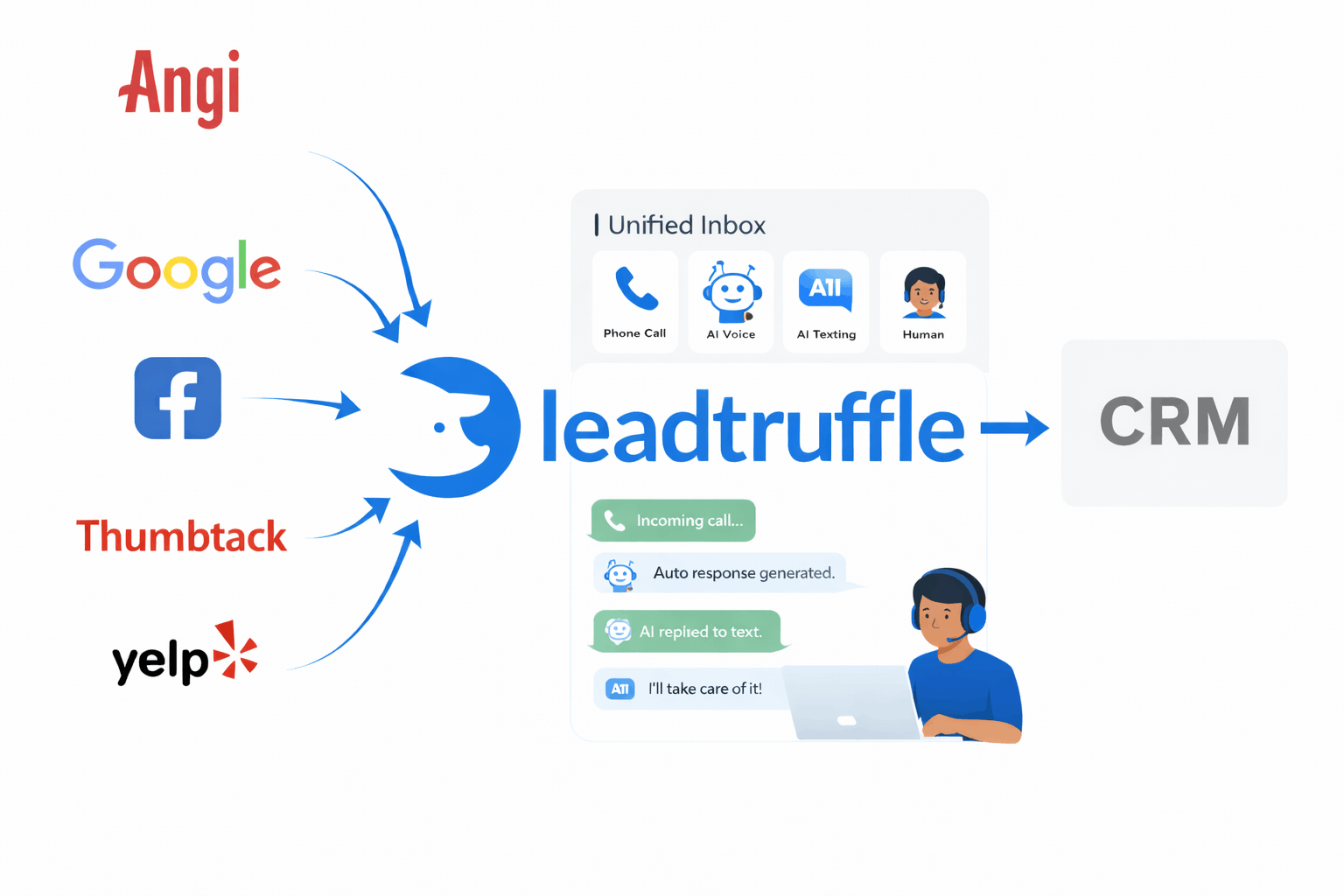
If you do use aggregator platforms, responding to those leads as fast as possible is the only way to make the economics work. Having your leads from Yelp, Angi, and Thumbtack flow into a unified inbox where you can respond immediately helps.
The Cost Math
A $35 shared lead that closes at 10% = $350 per customer. A $50 exclusive lead from your own ads that closes at 25% = $200 per customer. And the exclusive lead came through your brand, which means the customer is more likely to call you again next season.
Referrals: The Highest-Converting Channel
Referral leads close at 40-60% because trust is already established. Someone’s neighbor told them you do good work. They’re not comparison shopping -they’re ready to hire.
Building a Referral System
Don’t leave referrals to chance. Create a repeatable process:
- Ask after every job -“If you know anyone who needs landscaping help, we’d appreciate you passing along our name”
- Offer an incentive -$50 credit toward next service, gift card, or discount on their maintenance plan
- Follow up -send a text or email at 30, 60, and 90 days after service
- Deliver rewards promptly -this reinforces the behavior
Yard Signs
Operators consistently report that yard signs placed near completed jobs work better than random placement. The neighbor sees a fresh, beautiful yard with your sign in it and thinks “I should call them.”
Tips from operators:
- Place signs at completed jobs with homeowner permission
- Use unique phone numbers or QR codes for tracking
- Remove signs after 2-3 weeks (don’t let them become eyesores)
- Focus on neighborhoods where you already have multiple customers
Strategic Partnerships
Build referral relationships with:
- Real estate agents -curb appeal matters for home sales
- Property managers -they need reliable maintenance contractors
- HOAs -community-wide contracts can be significant revenue
- Irrigation and pool companies -adjacent services, natural referrals
- General contractors -new construction often needs landscaping
AI and the Changing Discovery Landscape
BrightLocal’s 2026 survey reported that consumer use of generative AI tools like ChatGPT for local service recommendations rose from 6% to 45%. Even if that number settles down, it signals a shift in how homeowners find contractors.
What this means practically:
- Structured information wins -AI tools pull from well-organized websites, complete Google profiles, and review content
- Reviews become even more important -AI models weigh review content heavily when making recommendations
- Clear service descriptions help -vague “we do it all” messaging doesn’t give AI enough signal to recommend you
- Consistent information across platforms -your name, services, and contact info should match everywhere
This isn’t a reason to panic or change your entire strategy. But it reinforces that the fundamentals -complete profiles, fresh reviews, well-organized websites -matter more than ever.
Speed to Lead: The Factor That Multiplies Everything
Every channel in this guide works better when you respond faster. This is true across every trade, but landscaping has a specific problem: you’re usually outside, on a mower, or driving between jobs when leads come in.
Google directly ties LSA ranking to responsiveness. Homeowners picking between five landscapers choose whoever calls back first. Every minute of delay reduces your close rate.
How to Respond Faster
- Instant text-back automation -when someone fills out your website form, send an automatic text within seconds acknowledging their request
- Missed call text-back -when you can’t answer the phone, automatically text the caller so they know you got their call
- AI qualification -let an AI system handle initial lead questions over text while you’re working, then review qualified leads when you have a break
- Notifications on your phone -every lead should trigger an immediate push notification
- Dedicated lead response -if you have office staff, make lead response their top priority
The goal isn’t to replace personal follow-up. It’s to make sure no lead waits more than a few minutes for a response while you’re out doing the work.
Tracking What Works
If you don’t measure results, you’re guessing where to spend money. Track these metrics:
Cost per lead by channel -know whether your Google leads cost $90 and your referrals cost $0. This determines budget allocation.
Close rate by source -referrals might close at 50% while Thumbtack leads close at 12%. A $0 referral lead that closes half the time is infinitely better than a $35 shared lead that closes 12%.
Customer lifetime value -landscaping has a major advantage here. A lawn maintenance contract might be worth $200/month for years. A one-time cleanup is worth $300 once. Focus marketing on services that create recurring revenue.
Response time -measure it, track it, and work to improve it every month.
Seasonal performance -compare April vs. July results. Adjust budget and channel mix based on what actually converts each season.
Use tracking phone numbers for different sources. Ask every customer how they found you. Review numbers monthly and shift budget toward what works.
Common Mistakes
Ignoring Seasonality
Running the same marketing plan in April and October doesn’t work for landscaping. Build campaigns around seasonal demand: spring cleanup, summer maintenance, fall leaf removal, winter snow services. Front-load your ad spend before peak season, not during it.
Neglecting Reviews
A landscaping company with 8 reviews and a 3.8-star rating will lose to a competitor with 60 reviews and a 4.7-star rating, even if the 3.8-star company does better work. Make review collection part of your post-job process.
Slow Response to Leads
This is worth repeating because it’s the most common and most expensive mistake. Hours-long response times kill your close rate and your LSA ranking. Fix response time before spending more on lead generation.
Relying on One Channel
If all your leads come from Angi and they raise prices or change the algorithm, you’re stuck. Diversify across owned channels (SEO, website), paid channels (LSA, Google Ads), and relationship channels (referrals, partnerships).
Sending All Traffic to Your Homepage
Your homepage doesn’t rank for “patio installation in [city].” Create dedicated landing pages for each service and location. Google Ads, LSA, and even social ads perform better when they land on a page that matches the search intent.
What to Do Next
Here’s a practical sequence whether you’re starting fresh or improving an existing strategy:
1. Claim and optimize your Google Business Profile This is free and generates leads. Add 15+ photos, start collecting reviews, define your service areas, and fill out every field.
2. Set up your website for conversions Phone number prominent on every page. Contact form that works on mobile. Service pages for each offering. Location pages for each city you serve.
3. Fix your response time Set up instant text-back for website forms and missed calls. Measure how fast you’re actually responding and improve it weekly.
4. Start Google LSA Landscaping, lawn care, tree services, and snow removal are all eligible. The Google Guaranteed badge plus pay-per-lead pricing makes this the best starting paid channel for most landscapers.
5. Build your referral system Ask every customer. Offer an incentive. Follow up. Place yard signs at completed jobs.
6. Start generating reviews Text customers a review link the day you complete their project. Respond to every review you receive. Aim for 20+ reviews within your first few months.
7. Invest in SEO content Create service pages, location pages, and blog content answering homeowner questions. This takes months to pay off but the results compound.
8. Test paid channels Once LSA is running, test Google search ads and Facebook/Instagram ads. Measure cost per lead and close rate for each. Put more money into what works.
9. Track everything Use tracking numbers, ask every customer how they found you, and review ROI by channel monthly.
Speed Up Your Lead Response
The fastest way to close more landscaping jobs is responding to leads faster. Contractors who respond in under 5 minutes close significantly more work than those who take hours -and for landscapers who are out in the field all day, that gap is even harder to close manually.
LeadTruffle helps landscaping companies respond instantly to website leads, missed calls, and form submissions. The AI qualifies leads through text conversation while you’re on the job, collecting details like service needed, address, timeline, and budget -then hands off qualified leads ready for you to quote.
All your leads from every source -website, missed calls, Google LSA, Yelp, Angi, Thumbtack -show up in one unified inbox. No more checking five different apps between jobs.